One price on Monday sets up the trade for the entire week.
It's called the Weekly Anchor. Both the entry and the risk come from that one level, so there's nothing left to decide mid-week.

How one candle sets the level
A large green daily candle is not a chart pattern. It's a record of an imbalance.
The body of that candle is the distance between where the stock opened and where it closed. When that distance is unusually large, buyers took everything that was available that day and kept going. The stock didn't drift higher. It was moved.
That’s how Monday becomes the anchor. It's the level the market established while it was buying with conviction.
This anchor does two jobs.
The first is reference. As long as the stock holds above the level where that buying happened, the imbalance is still intact. When it doesn't, the reason for being in the trade is gone. You're not interpreting the stock. You're comparing one number to another.
The second is risk. Most methods take the entry from one place and the stop from somewhere else, like a moving average, a fixed percentage, or a recent low. When those two numbers come from unrelated sources, the stop has no real connection to the reason for the trade.
That's why so many traders end up renegotiating a stop in the middle of the week. When the entry and the risk both come off the same candle, there is nothing to renegotiate. The Weekly Anchor holds or it doesn't.
That's why the decisions get made on Monday. Not because Monday is special, but because by Monday's close the market has already shown you both of the things the trade depends on.
Why the adjustments are sized to the stock
A stock that routinely moves four percent a day and a stock that moves one percent a day should not be managed the same way. Most traders use the same trailing stop on both.
On the quiet stock, that stop sits too far away and gives back more of the move than it needs to. On the volatile stock, it sits inside the range that stock covers on an ordinary day, so normal movement ends a trade that was working.
This is the reason a lot of part-time traders decide they're bad at exits. Usually they're applying one rule to stocks that require different ones.
The Weekly Anchor scales the adjustment to each stock's own volatility, so protection tightens at a rate that particular stock can tolerate. Those levels are worked out when the trade is planned, not while it's running.
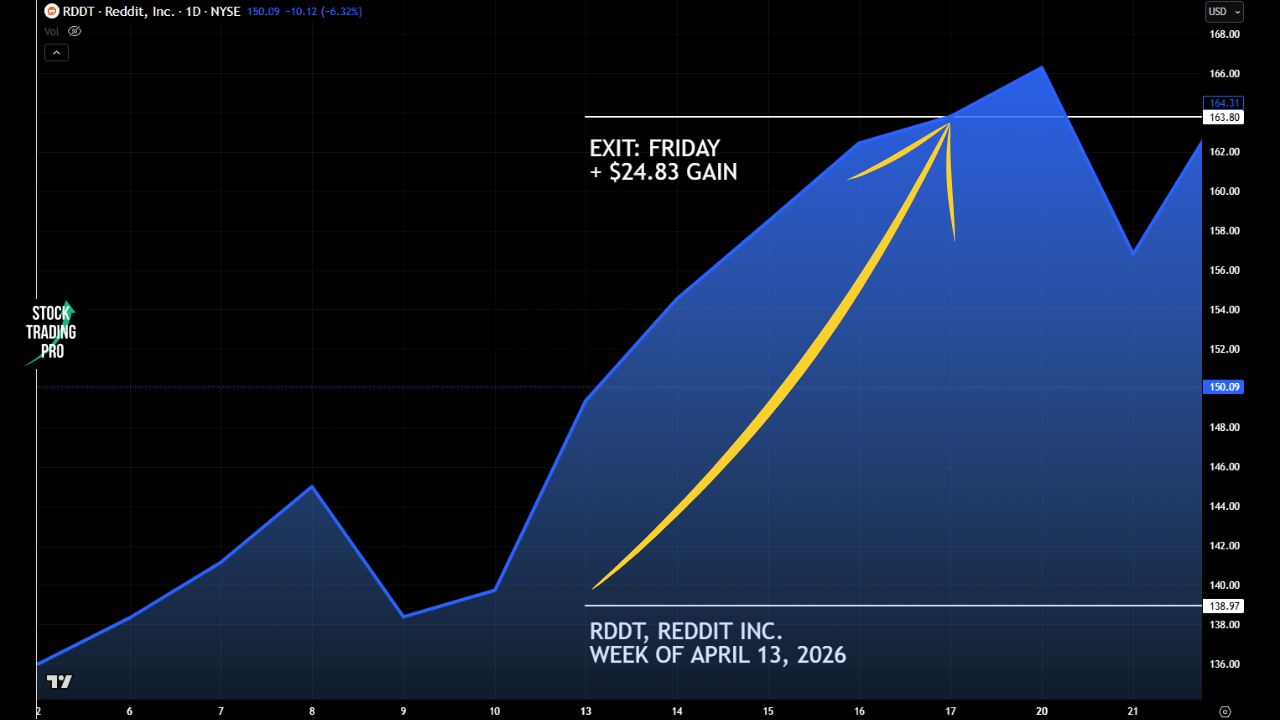
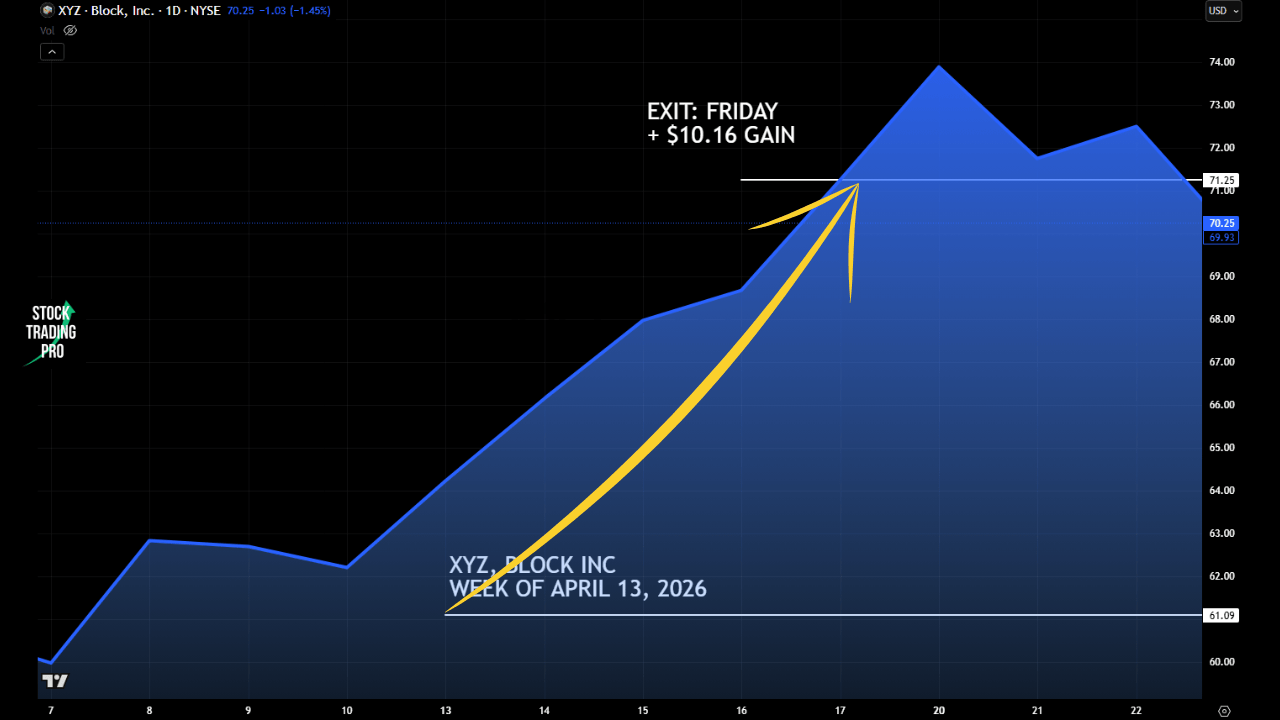
What this is, and what it isn't
The Weekly Anchor is one setup. It is not going to tell you how to interpret an earnings report, what the Fed is going to do or how to trade options. It's a specific way to structure a swing trade around a single Monday price level.
Implementation of The Weekly Anchor strategy requires a basic knowledge of common technical analysis principles such as candlestick charts as well as how to place orders.
What it does provide is a repeatable process that takes about 40 minutes each week.
One setup, learned properly, that fits alongside everything else you already do.
What the week looks like
 Monday
(About 30 minutes)
Run the prebuilt scan. It returns the stocks showing an anchor setup that day.
Take the ones that qualify through the position calculator. It works out the entry, the risk, and where the adjustment levels sit for that particular stock, based on how that stock actually moves.
Place the order. The stop goes in with it
Trade adjustments
(No screen time required)
The stop is already in the market. The adjustment levels are already decided. Nothing about the trade depends on you being available.
If the stock advances into a level you set on Monday, the adjustment is already defined. If it doesn't, the stop handles it.
Friday
(ABOUT 10 minutes)
Close the position, or carry it into the next week using the Weekly Anchor profit protocols.
That's the week. One session to set it up, one to close it out.
The reason this might seem too simple is because the decisions are made when the information for this strategy is available, which is Monday.
WHAT'S INCLUDED:
The Weekly Anchor
Nine training modules, about 90 minutes total.
Simplifying the Stock Market
 The profits and expenses framework, and how thinking in those terms changes what a losing trade means.
Why Stocks Move Up and Down
The four catalysts that create institutional buying, and how to know when one is in play without watching financial news.
Shadowing Not Predicting
Why the method never requires a forecast, and what you follow instead.
Accepting Risk
The difference between taking risk and accepting it, and why the second one is what makes a stop loss hold.
How and When to Buy
The Monday window that sets up the week, and what to do if you miss it.
Finding Stocks to Buy
The scanner setup, step by step with screenshots, narrowing the market down to a short list of candidates.
Scanning Stocks to Buy
The filtering and visual confirmation that separates a qualifying setup from one that only looks like one.
Making Money - Managing Trades
The complete trade management system: when the position gets added to, when the stop moves, and how the exit is decided.
BONUS #1:
Quick Start
Implementation Guide
 The Monday checklist, a set of yes or no questions that tell you whether a setup qualifies.
 Emergency Exits Scenarios Quick Reference Formulas
BONUS #2:
The Weekly Anchor Position Calculator
A fill-in form that requires every decision to be made before money is at risk. It flags when the risk on a trade is out of proportion to how that stock normally moves.
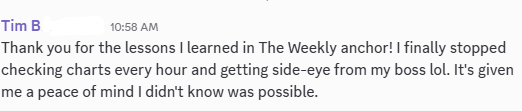
"I finally stopped checking charts every hour... The Weekly Anchor has given me a peace of mind I didn't know was possible."
~ Tim B.

" It's amazing how looking at Monday's open price brings this in focus."
~ Gabe H.
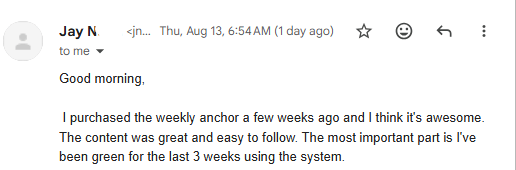
I purchased the weekly anchor a few weeks ago and I think it's awesome.
The content was great and easy to follow.
The most important part is I've been green for the last 3 weeks using the system.
~ Jay N.

"Weekly Anchor course is fantastic .. full of AHAs!"
~ Alice I.

"Having a weekly anchor gives me a system for weekly success that feels more like a paycheck than the time suck of day trading.
You've given me my life back."
~ Tracey P.
Hi, I'm Pete Renzulli

I've been in the trading business for over 30 years.
I became a full-time trader in April 2000 and went on to own one of the larger trading firms in New York City, with roughly 300 traders trading my capital.
One question kept coming up while I was running it. Institutions were consistently profitable and retail traders weren't, and the gap didn't come down to information or intelligence.
The answer came out of working alongside former NYSE specialists, floor clerks, and brokers. We reverse engineered how institutional trading actually operates: not the theory, the mechanics. That work became the foundation of everything I teach.
The Weekly Anchor is one piece of it. It's the setup I'd hand to someone who wants to learn the approach through a single, well-defined trade rather than all at once.
get iNSTANT ACCESS TO:

✓ All 9 core training modules (90 minutes)
✓ Quick Start Implementation Guide
✓ The Weekly Anchor Position Calculator
✓ The prebuilt scan
✓ Instant digital access
✓ 14-day money-back guarantee
$49 / one time charge

My 14-Day "Complete Satisfaction" Guarantee
Go through the modules. Run the scan on a Monday. See whether the process holds up against the way you actually trade.
If it doesn't give you a defined setup you can run on your own, email support within 14 calendar days and we'll refund you.
No forms, no questions.
Frequently Asked Questions
Other systems require constant monitoring, and leave the exit as a judgment call made in the middle of the week. That's the part that tends to break down, especially if you can't watch the market during the day.
The Weekly Anchor Method is designed around your constraints, not against them.
Two decisions per week. No monitoring. Trades that hold while you work.
The adjustment levels are sized to each individual stock's volatility, so a stock that moves more gets more room.
That said, there are market conditions where few setups qualify. In those weeks the method tells you to sit out, and sitting out is a legitimate outcome.
No.
You can use this method with Finviz.com (free version) and your broker's basic charting.
The system identifies institutional accumulation (buying pressure).
Bull markets: Lots of opportunities
Choppy markets: Fewer opportunities (trade less)
Bear markets: Very few opportunities (mostly cash)
The system tells you WHEN opportunity exists. You're not forced to trade in poor conditions.
About 30 minutes on Monday and 10 minutes on Friday, once you know the process. Learning it takes about 90 minutes plus whatever time you spend going through the material a second time.
Implementation of The Weekly Anchor strategy requires a basic knowledge of common technical analysis principles such as candlestick charts as well as how to place orders.
One setup, learned properly
The Weekly Anchor isn't going to tell you everything about the stock market. It's one method, built around one price level, that you can run in about 40 minutes a week and repeat without improvising.
If that's what you're after, it's $49 and you have 14 days to decide.
 Secure Checkout | ✓ Instant Access |
  14-Day Guarantee
Questions?
Send us an email: [email protected]
Refund Policy and Delivery | Terms of Service | Disclaimer | Privacy Policy
(C) Copyright 2026 Stock Trading Pro LLC
IMPORTANT DISCLOSURE:
All trading involves substantial risk of loss. Stock trading can result in the complete loss of your investment. Past performance does not guarantee future results. The performance results shown reflect historical back-tested and actual trading results and are not indicative of future performance. Individual results may vary significantly.
The information provided is for educational purposes only and should not be considered personalized investment advice. Always consult with a qualified financial advisor before making investment decisions.