Why day traders who “know everything”
can’t get profitable.
It’s not because you lack discipline, it’s not because you need to know more and it’s not because you don’t have what it takes.
You might have finally stopped losing, but your account’s not growing.
You’re not getting paid.
The issue isn't "mindset."
It's that you were taught to manage risk, but never learned how to manage profits. You’re so focused on not losing that you never learned how to win.
 You stopped revenge trading.
You stopped blowing through stops.
You stopped letting one bad morning erase a good week.
The loss side of your trading is under control.
But your day trading account still isn't moving the way it should.
Here's why. 
You learned to cut your losses short. Great.
That was the right lesson and you learned it well. But somewhere along the way, the same instinct that protects you from big losses is holding you back on your winners.
And so you cut both. Losses and gains. Contained, managed, and small.
This has a name. It's called Pinching Your Profits.
And it doesn't show up as a blowup or a catastrophic loss.
It shows up as an equity curve that goes nowhere.
Controlled losing. Consistent breakeven.
The slow frustration of a trader who knows what they're doing and still can't call themselves profitable.
You fixed half the equation. You just stopped short of finishing the task.
Going From Not Losing To Winning
Every course, every community, every YouTube video was built around the same message: protect your capital, manage your risk, control your losses.
That advice is correct. You followed it. You got good at it.
What nobody told you is that protecting capital is necessary but it’s like driving with your foot on the brakes.
You applied the right solution to the wrong problem. And the result is a trader who is doing almost everything correctly and still can't call themselves profitable.
Day Trading Insights From My NYC Office
My name is Pete Renzulli.
I owned and operated Keystone Trading Group in NYC. Our office was at 450 7th Ave, right next to Madison Square Garden.
At one point we had over 300 traders globally, and profitably day traded tens of millions of shares per month.

Because of my “real money” experience, I’m uniquely qualified to show you the path to consistency.
In a legendary collaboration with 25 former New York Stock Exchange specialists and floor brokers we created the order flow stacking method. It’s a simple way to shadow the dominant side of the market.
The reason it’s superior, and unlike most day trading strategies is that we’re always on the right side of the order flow. Which means when we’re right, the rewards are as reliable as a Swiss watch.
We built a way to manage the process, not the price action. This is where you’re likely struggling. You're trying to predict the next move.
Consistently profitable traders NEVER predict, forecast or hope. We follow systems.
The Path To Consistent Day Trading Profits
 Here's what changes everything.
Profitability is not built by minimizing bad trades. It's built by letting good trades become great ones — consistently, mechanically, and without second-guessing.
One trade is not the unit of measurement for a profitable trader. Fifty trades are. One hundred trades are. A single winner you cut short is not a small failure.
Cutting every winner short across a hundred-trade sample is why the account doesn't grow.
The traders who get consistent don't have better entries than you. They don't have more discipline. They have a process for building winners that removes fear from the decision.
When the trade works, the process tells them to add to it, not exit it. When the profit grows, the process manages the exit mechanically — not emotionally.
Your losses don't need to get smaller. Your winners need to get bigger. That's the half of the equation you haven't solved yet.
That's what Daily Deposits is built to do.
This is how day traders get consistent.

What’s Included In the Daily Deposits Training
1. Minimum Viable Criteria (MVC)
A pre-entry qualification filter developed from years of institutional trading experience. It exists because most traders enter too early, too late, or in the wrong stock entirely, not because their setup failed, but because the stock was never qualified to begin with.
MVC establishes a clear, non-negotiable standard a stock must meet before you ever look for an entry.
So you can stop wasting trades on setups that were never valid — and only put capital to work when the conditions are already stacked in your favor.
2. Stacked Order Flow
The foundational edge the entire system is built on. Developed collaboratively with former New York Stock Exchange Specialists who spent their careers reading and managing institutional order flow on the exchange floor.
It targets liquid, high-movement market leaders where institutional money is already moving, giving you a structural reason to be in the trade, not just a technical one.
So you can trade with an actual edge behind every position — not a pattern, not a gut feeling, but a proven alignment with how institutional money moves.
3. Core Entry Setups
Three specific entry triggers, each designed for a different market condition. Two capture momentum at breakout points. One captures a reversal inside a qualified trend.
They exist because no single entry type works in every environment — and having the right trigger for the right condition is what separates precise execution from guessing.
So you can enter trades at the highest-probability moment instead of chasing moves that have already happened or forcing entries in conditions that don't fit.
4. Probability Boosters
A secondary confirmation layer that measures the broader market environment before you commit to a trade. It exists because even the best individual setup fails at a higher rate when the market, sector, and industry are working against it.
Probability Boosters amplify the odds of a winning trade, sets the tone for risk and the size of the expected initial profit.
So you can increase the conviction behind every trade you take — and filter out setups that look right on one chart but are swimming against the current everywhere else.
5. Profitability Boosters
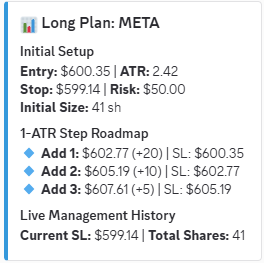
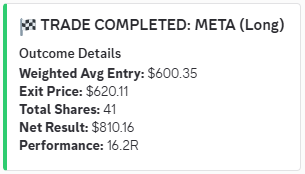
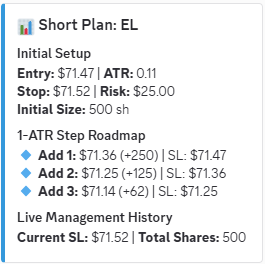
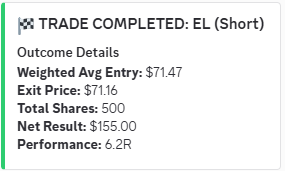
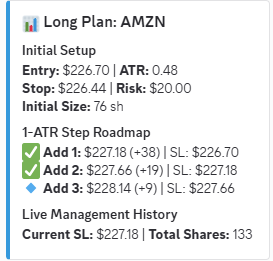
This is the secret sauce. A structured position-building protocol that tells you exactly when and how to add to a trade that is already working. Same trade. Bigger profits without bigger risk.
Never again be at maximum size before the market validates your trade. Never again be at minimum size when you have a winner.
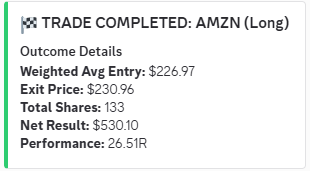
Profitability Boosters invert that relationship entirely. Same entry, same exit but much bigger P&L.
So you can carry your largest position on your best trades — the ones the market is already confirming — and your smallest position on trades that haven't earned it yet.
6. Momentum Profit Maximizer (MPM)
A mechanical exit process designed specifically for fast-moving market conditions. It exists because momentum trades move quickly and require a simple, clear rule that keeps you in the trade while it's running without requiring a real-time judgment call at every candle.
The exit is defined by price action, not by how you feel about the profit sitting in your account.
So you can stay in a momentum trade long enough to collect what it's offering — without freezing at the screen or talking yourself out early.
7. Trend Profit Maximizer (TPM)
A two-stage exit process built for trades that have the potential to develop into a larger trend. It exists because trend trades require a different kind of patience than momentum trades — and exiting them the same way leaves significant profit on the table.
The TPM activates only after a minimum profit threshold is reached, and exits on a specific technical signal rather than a profit target.
So you can hold your best trades long enough for them to become great ones — with a defined exit that removes the fear of giving back gains and replaces it with a process.