
How to achieve bigger wins without increasing your risk.
Here's how the best swing traders use "Trade Scripting" to
lock in smaller, controlled losses while systematically
multiplying their biggest winners....
Trying to make every trade a winner is exhausting.
It forces you to overthink, hesitate, and second-guess your strategy.
The pros don't play that game.
Because they know the real secret isn't winning more often, it's squeezing every drop of profit from the winners you do hit, without ever compounding your risk.
How to know if your approach needs to change...
You called it right, got stopped out (again), then watched it run without you.
It starts the night before.
You run your scans, narrow the list, and settle on the one that’s set up.
You set the buy stop, mark your stop loss and go to work.
The next session, the order fills.
Then two days later one red candle pulls back just far enough to take you out. You move on.
A few days later you check the chart and the stock is sitting past your target, without you.
Your analysis was right. Your plan was right. You still got left behind.
CHART READING IS NOT TRADING
Studying technical analysis is worth the effort.
But the trade is won or lost after the entry.
Think about how you spent those hours. Studying setups. Testing indicators.
Learning to spot the pattern a little earlier, a little cleaner than last time. This made you a better chart reader.
But here's the disconnect...
Nobody opens a trading account to become the world's best chart reader.
You opened it to make money as a trader.
Chart reading is not trading. And unfortunately that's the skill most spend years try to improve.
Reading the chart finds the entry.
Trading is what happens after it: when to hold, when to add, when to step aside, when to let it run.
They are not the same skill.
One gets you into the trade.
The other decides if you're profitable.
Ask most traders what their plan is, and they'll map the setup, the entry and the stop.
Then ask what the plan is after they buy, and silence.
That is the problem. No plan exists for after the entry.
So when the position moves every tick is a question.  It ticks up, do you take it? It ticks down, do you bail? It stalls, do you hold or cut it?
When you don't decide any of this in advance, you have to decide all of it live, while your money is on the line.
At my trading firm, we called this Price Action Pinball.
Knocked from one decision to the next by every move the stock makes, reacting instead of executing, until you bail on a good trade or hang onto a bad one a beat too long.
So, you go looking for a new answer.
Most traders do. And almost everything you find, hits the same wall.
 A course teaches you what to look at.
It is the right place to learn the setup, the structure, the pattern.
But a course is static, and the after-entry part is anything but.
Once you are in, the stock starts moving and the questions multiply faster than any lessons answer.
What if it gaps? What if it stalls here? What if it runs, then reverses?
A recorded lesson cannot answer the question in front of you, because every trade asks a different question.
YouTube has a different job.
Free videos hold your attention and bring you back tomorrow.
You can watch it for a year and still be left with the same gap the moment you are in a live trade: nobody showed you what to do when it moves.
Chat rooms are the strangest fit of all.
This is why: a room runs live, all day, reacting to intraday price action.
The moment you're watching five-minute candles, you are not swing trading anymore.
You are day trading.
None of these fix Price Action Pinball.
The pattern is the same every time. Each one helps you find the trade. None of them gives you a plan for after entry.
You didn't fail because you lacked discipline.
You failed because everything you tried stopped after you hit buy.
Managing the trade does not need to be a fight.
The battle exists because you're reacting.

Hi, I'm Pete Renzulli
I've traded stocks professionally for over 26 years.
I became a full-time trader in April 2000 and founded one of New York City's larger proprietary trading firms — Keystone Trading Group — where roughly 300 traders traded my capital.
Behind the firm's success, one question kept surfacing: why were institutions so consistently profitable, while retail traders struggled? The answer came from a collaboration with 25 former NYSE specialists, floor clerks, and brokers who traded under my roof.
Together, we reverse-engineered institutional behavior. Not theories. Not headlines. The actual mechanics behind consistent institutional profits.
Today more than 39,000 traders across the globe follow my systematic roadmap, replacing gut feelings with repeatable edge — sparing them the emotional whipsaw that wrecks most accounts.
I stood on both sides of the game. I know the instant an institution has your back and the sick drop when you realize it doesn't.
My mission: translate that institutional certainty into clear rules any serious trader can execute.
A RELIABLE PATH TO BIGGER WINS WITHOUT INCREASING RISK
There are two ways to trade. One is random, the other is mechanical. Discretionary, where you make your decisions as the price action unfolds in front of you.
  And mechanical, where the decisions are already made before the trade begins, and your only job is to execute them.
Discretionary traders struggle and have no idea why.
Because every spur of the moment decision leads to one place: Price Action Pinball.
Random decisions lead to random results.
Mechanical trading is reliable, repeatable.
Every decision, every adjustment is made in advance:
 When to build a position.How to manage unrealized gains without fear. How to adjust a trailing stops to lock in gains. Where you take the first profit, and how you manage what is left once that profit is hit.
All of it decided before, written down, like a recipe.
We call this Trade Scripting. The entire trade mapped from entry to exit before it begins.
Once it is written, you are no longer reading the price action and deciding what to do. You are executing decisions you made when you were calm. This works because emotions never get a vote, because nothing remains to decide.
One rule drives every trade: I do not know when I am getting out, but I know where.
But a script is only as good as the quality of the idea. Each script begins with Institutional Shadowing. Our process specifically identifies stocks under active accumulation by the smart money.
This works because it aligns your scripts with massive, dominant order flow, ensuring your setups have the highest mathematical probability of success before you ever write the first rule.
Once we have the right stocks, then we script the trade.
The secret behind this consistency is Trade Scripting.
Instead of guessing when to buy more, we build positions using strict rules.
Once a trade is moving in your favor, the system uses Validated Scaling.
Instead of holding the exact same amount of shares from start to finish, we add to positions as the trade wins.
This works because it makes sure you have the largest possible size on your winning trades, while at the very same time locking in your profits and cutting your risk as the position grows.
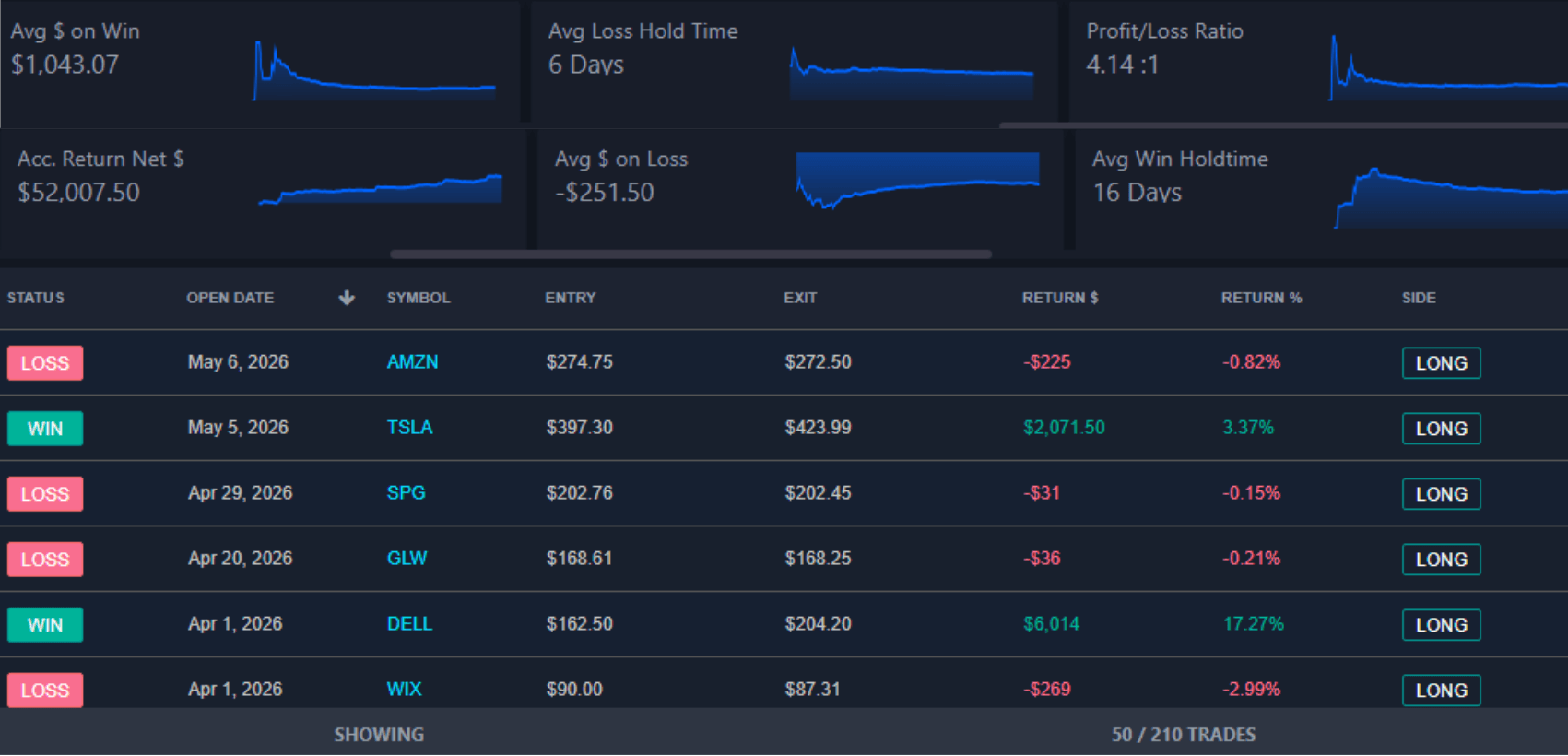
The result is a hands-off process that creates huge wins and tiny losses.
This is exactly how winning traders stay highly profitable, even if 60% of their setups fail.
What if trading success was never about how often you win?
The engine that drives this math is Trade Scripting. Instead of focusing on win rate, this mechanism is structurally engineered to maximize the size of your winning trades while keeping your failures strictly capped.
Once a trade is live, the system applies Pre-Planned Structural Holds. The position is built and protected by a strict set of rules decided before the trade ever opens.
This works because it allows your trade to grow large without giving back what it has already made, ensuring it is held through the meat of the move by a mathematical rule, not by nerve.
To achieve this, the mechanism utilizes Dynamic Trailing Exits. To capture the bulk of a massive move, the system is designed to give a little bit back at the very end when the exit finally releases.
This works because the few points you return are exactly what you pay to find out how far a trade can run. The trades that run far easily cover every controlled loss. Refuse to give any of it back, and you cap every winner at the size of a scratch.
The result is a fully mechanical process where you can be wrong on most of your trades and still finish well ahead, because the few that work are managed to their absolute maximum size.
And This Is Where The Method Stops Resembling Anything You've Seen
This maximum size is achieved through Volatility-Based Accumulation. Instead of waiting for arbitrary chart patterns to give permission, the position grows based strictly on the stock's own volatility.
This works because each stock naturally dictates exactly how much room it needs to move. There is always a mechanical plan for your next addition, and it never has to wait on the chart to cooperate.
This triggers a structure of Inverse Risk Scaling, where your position gets bigger while your actual risk gets smaller. Every time you add size, the system automatically brings your protection up behind it, pulling risk off the table.
This works because it structurally engineers the mathematical opposite of traditional trading: it ensures you are carrying your absolute largest position size at the exact moment of least danger—with your worst-case scenario locked in as a profit.
Finally, the trade concludes using Dual-Phase Profit Targeting. The run happens in two distinct acts. First, it hits a defined target to bank a real win and put a hard floor under the trade. Only then does the structure shift from protecting a known win to chasing an unknown one, trailing the move for as far as it will go.
While generic methods force you to choose between securing a quick profit or holding for a runner, this structure mechanically guarantees both. It gives you the win first, and the runner second.
I really like how you connect macro data, sentiment and small cap price action all in one summary."
— Christian C.
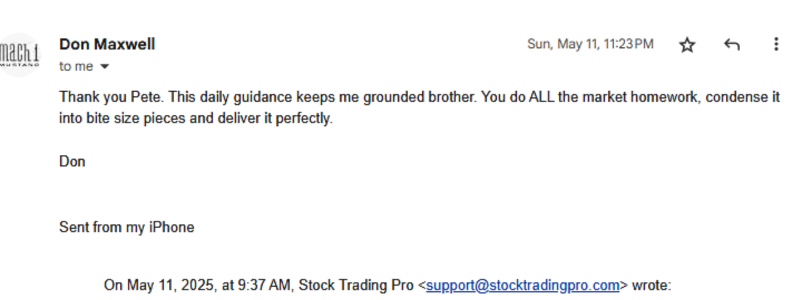
and deliver it perfectly."
— Don M.
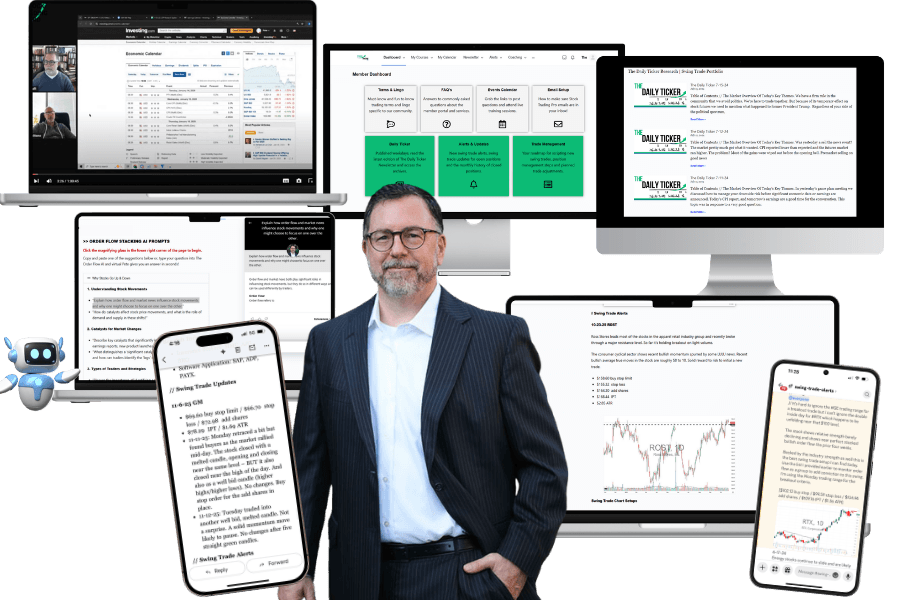

HERE'S WHAT YOU GET WHEN YOU JOIN THE DAILY TICKER TODAY:
Newsletter Research
The engine driving this time-saving approach is The Daily Ticker’s Power Pyramid methodology. Instead of spending hours scanning charts or guessing which sectors are moving, this system does the heavy lifting of market research to deliver ready-to-execute trades directly to you.
It starts with tracking Bullish Stacked Order Flow. Rather than chasing random market headlines, the newsletter curates a specific watchlist of stocks based entirely on institutional trading patterns.
Automatically align your setups with the dominant market trend. You are only stepping into trades backed by massive institutional momentum, increasing your probability of success before you ever enter the market.
Swing Trade Scripted Setups
Pre-Planned Swing Setups. Each morning, you receive the complete structure for every trade, including the optimal entry zones, risk limits, and profit targets.
The risk is strictly defined for you in advance, allowing you to execute the plan without watching the market during your workday.
Swing Trade Management Alerts
You get clear, daily updates on exactly when to add shares, adjust your stops, or take profits.
The secret to capturing big moves without giving back your profits is the system's Adaptive Trade Scripting.
Once a trade is live, the software applies Validated Scaling. Instead of holding a static amount of shares, the system dynamically builds your position, adding shares only when the stock powers through confirmed, profitable levels.
This works because it mathematically ensures you have the largest possible position size on your winning trades, while locking in your profits and moving your stop-loss up to shrink your downside risk.
The result is an automated process where your biggest positions carry the smallest risk, allowing you to trap your gains and stay profitable even if the stock reverses.
Software: Trade Manager Pro
Trade Manager Pro removes the real-time emotional chaos of managing live trades. It covers every possible scenario with a pre-planned response.
Trade Script Generator: Instead of trading keeping you glued to the screen, you script every decision in advance, so the trade simply follows the plan your rational self already approved.
Exact Position Sizing & Dollar Risk: Your size is matched to volatility and your risk is locked in as a specific dollar amount you accept before entry—exactly how professional risk management is taught.
3:1 profit targets, adds, and trailing stops: Every trade begins with an asymmetric payoff plan and clear rules for adding and exiting, so your behavior finally matches the math behind long‑term profitable swing trading.
Home-Study Course: Swing Traders Blueprint
The power of this approach comes from how it builds every trade in a specific sequence.
It starts with defining a clear edge. Before you take on any risk, the system isolates the exact reason why the market should move in your favor over time. Instead of obsessing over whether one trade wins or loses, you let your advantage play out over a larger sample size, letting the math do the work.
With your edge established, the system forces you to accept risk upfront. It structures your setups so that inevitable losses are kept tiny and treated as a normal business expense. It forces you to define the exact dollar amount at risk before you enter. By locking down that number upfront, your account is financially protected from the start.
The framework controls when you enter. It prevents you from chasing a stock or getting in too late. This ensures you only enter a trade at the exact spot where the reward justifies the risk you just accepted.
The system also controls how you collect profits. First, it requires clear initial profit targets. This forces you to only accept trades that are a genuinely good deal, where the payout heavily outweighs the risk. Once that first target is hit, the system shifts to profit maximization. This gives you a mechanical way to move beyond your initial targets and capture the biggest gains as the stock continues to run.
The result is a low-stress, swing trading process that maximizes your winning trades while keeping your risk strictly controlled.
BONUS: Saturday Swing Trade Sessions
You're invited to a private strategy session with veteran traders Pete Renzulli and John Napolitano. Instead of trying to predict the market, these sessions engineer your upcoming week using a Predictive-Free Framework.
The core of this strategy relies on Institutional Position Building. You will see exactly how to accumulate positions across stocks and options using the same structured frameworks as the institutions. This mathematically defines your risk in advance and gives you the confidence to hold winning trades through inevitable market consolidations, rather than abandoning them early.
To bridge the gap between theory and execution, the sessions deliver Live Strategy Alignment. By actively reviewing the completed week and mapping out the precise plan for the week ahead, you see exactly how professionals position themselves for new sector rotations without stressing over intraday charts.
The result is freedom from the daily obsession with market timing. You walk away with a systematic, mathematically sound way to capture high-quality setups without needing to predict a single move.
The next meeting starts at 10 AM Eastern this Saturday.
BONUS: ChatSTP AI Coach
The all-new technology that accelerates your mastery of this strategy is known as ChatSTP. Unlike generic AI assistants that pull conflicting theory from the internet, this system strictly searches 100 hours of our proprietary training and coaching sessions. This ensures every answer is mathematically aligned with your exact trading methodology.
When you ask a question, the system delivers Video-Verified Answers. It instantly scans the training archive to return a text summary alongside direct, timestamped video links to the exact moment Pete taught that concept. This gives you immediate answers for speed, plus the ability to jump straight into Pete's chart explanations, saving you from ever scrubbing through old footage.
Finally, serving as your Private, On-Demand Coach, the system provides instant, judgment-free clarity on your schedule. Instead of waiting days for a live session, you get Pete's exact words and demonstrations exactly when you need them to build your trade plans.
The result is an accurate, instant-access knowledge base that ensures you never get stuck.
LIMITED TIME BONUS: Milestone Management
Milestone Management is a TradingView indicator that maps your entire trade before you click buy, calculating your position size, add levels, and profit target from each stock's own volatility.
As price reaches each milestone, you add to a trade that is working while your risk floor moves up to reduce the original capital at risk, and that floor never moves back down.
Your alerts are already built in, so instead of reacting to every candle, you simply take the predefined action when a milestone hits.
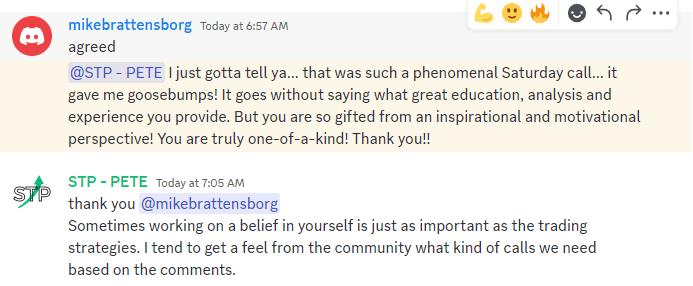
"...that was such a phenomenal Saturday call...
it gave me goosebumps!"
— Mike B.
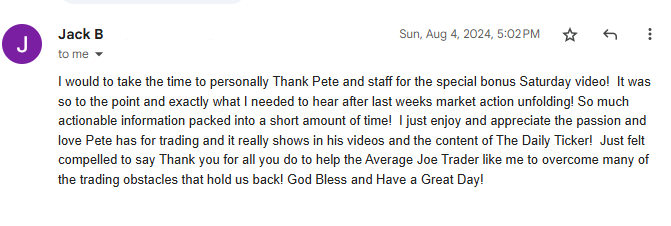
"So much actionable information packed into a short amount of time. It was exactly what I needed after last week's market action…
I just appreciate the passion and love Pete has for trading and it really shows in the content of The Daily Ticker."
— Jack B.
Frequently Asked Questions
The home study course starts with the fundamentals and builds systematically.
Plus, annual members get a 1-on-1 orientation to customize your learning path based on your experience level. Many of our most successful members started as complete beginners.
Most programs focus on retail strategies like chart patterns and technical indicators.
We stack institutional Order Flow - the same methodology Wall Street professionals use to read market intentions before moves happen. It's the difference between following the crowd and following the smart money.
The beauty of swing trading is that you don't need a large account to be profitable.
The system works with any account size because it focuses on percentage gains, not dollar amounts. We'll teach you proper position sizing and risk management regardless of your starting capital.
Absolutely! We have successful members worldwide.
Saturday's session is recorded and the replay is available immediately, swing trades don't require you to be glued to your screen during market hours, and the Discord alerts work globally. The system is designed for busy professionals regardless of location.
The Daily Ticker takes about 10-15 minutes to read. Placing your trades takes minutes.
Once you place a swing trade, it typically runs 3 days to 3 weeks with minimal monitoring required.
You can keep struggling with trading methods that don't fit your life,
or you can start using the same systematic approach that Wall Street professionals use to
generate consistent profits.
Questions? Email us at [email protected]