What 30 Years on Wall Street Taught Me About Options Trading
(And Why Most People Do It Backwards)
A Former $40 Billion Fund Manager Shares the Simple System That Institutions Actually Use —
While Everyone Else Chases Headlines
You know that sick feeling when you exit a trade early — only to watch it hit your target the next day?
Or when you spend hours researching the "perfect" setup, finally pull the trigger, then panic-sell the moment it moves against you?
Meanwhile, you're watching other traders post screenshots of the exact same trade — the one you just bailed on — making exactly the returns you wanted.
Here's what keeps happening to retail traders:
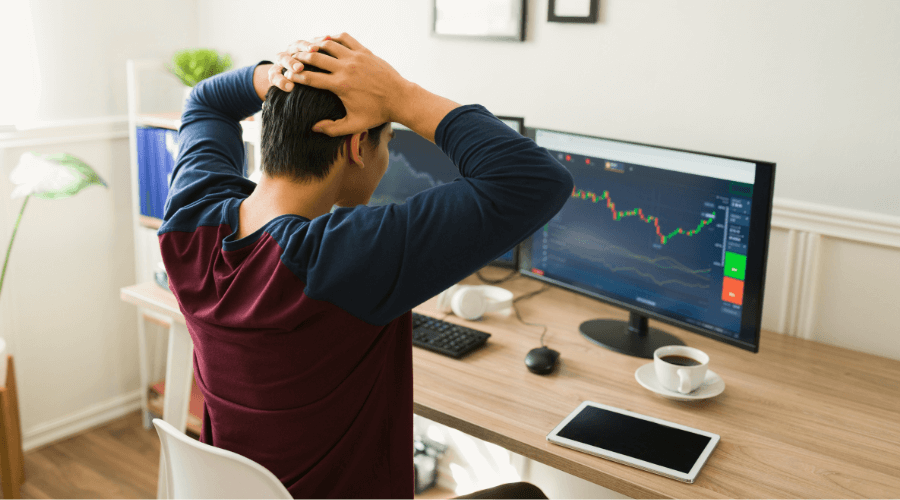
Monday: Spot a great setup, feel confident about your analysis
Tuesday: Enter the trade, market moves against you slightly
Wednesday: Panic-sell for a small loss, "cutting losses early"
Thursday: Watch your original trade hit target perfectly without you
Friday: Hate yourself, promise to "stick to the plan next time"
Sound familiar?
Here's the brutal truth: You're not failing because you're undisciplined or unlucky...
You're failing because you're playing a rigged game without knowing the rules.
While you're reading headlines, analyzing charts, and second-guessing every decision, billion-dollar institutions are making moves based on information you'll never see on CNBC or Twitter.
It's not your fault — you're just missing the institutional playbook.
You're making decisions based on incomplete information while the smart money already knows where the market is headed.
It was 10:47 AM on a Tuesday when John Napolitano realized something that would change how he thought about trading forever.
The market had been open for just over an hour, and around him in the Manhattan trading room, institutional traders were calmly executing large block orders — managing over $40 billion in assets for one of the world's most prestigious French banks.
But John noticed something that retail traders never see: While individual investors at home were reacting to the morning's headlines — Fed comments, earnings surprises, analyst upgrades — the institutional orders around him had already been positioned hours before the news hit.
While individual investors jumped from stock to stock based on headlines and hot tips, institutions were quietly moving massive amounts of capital using a systematic approach that most people never learn about.
"I watched the same scenario play out hundreds of times," John remembers. "Retail traders would panic-sell right when institutional money was backing up the truck to buy more."
That's when it hit him:
The game isn't about being smarter or faster. It's about knowing where the real money is going — and going there first.
Here's what makes this different from every other options "system" you've seen:
Instead of teaching you to trade options, John shows you how to think like institutions when they trade options.
You'll learn to spot the same patterns that billion-dollar funds use to generate consistent monthly income.
No complex charts. No hours of daily analysis. No gambling on earnings plays or meme stocks.
Just a systematic approach that takes an hour a week and aligns your trades with the smart money instead of fighting against it.
Plus:
Annual members get exclusive access to our breakthrough Coaching AI — trained on our extensive coaching call archive.
Now you can have instant access to professional-level guidance 24/7,
whether you're reviewing a trade at 6AM or second-guessing an exit strategy at 11PM.
My name is Pete Renzulli, and twenty five years ago,
I was exactly where you are right now.
I started day trading because I wanted more free time in my life and my regular job wasn't cutting it.
I kept seeing posts in chat rooms and forums about people making thousands in a day,
and I thought "if they can do it, why can't I?"
I figured I could turn my small savings into something substantial pretty quickly.
Maybe even quit my day job within a year.
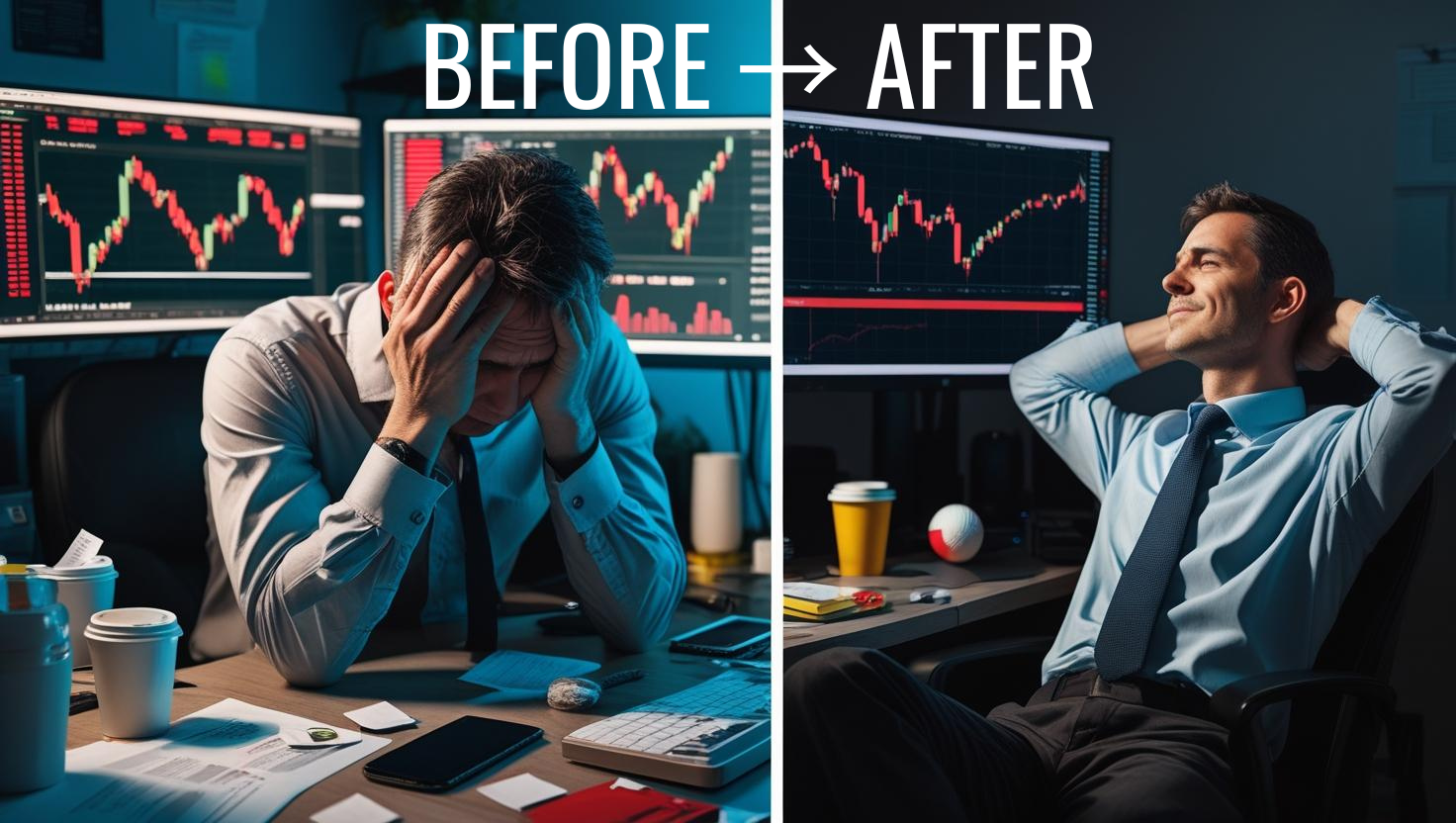
Within 90 days of joining this group, everything changed.
 I stopped being an emotional wreck making terrible decisions.
I learned to lose money without losing my mind.
My good days were no longer accidents - they became repeatable because I was finally trading with consistency.
More importantly, I gained control. Poise. I could wake up each morning knowing that regardless of what the market threw at me, I would stick to my rules.
Now, for the first time,
I'm opening up my private community to day traders who are tired of the emotional roller coaster.
The Day Trading Pro Community isn't another course promising secret strategies or overnight wealth.
It's a complete system that transforms how you think about day trading and the process of making money.
Our members have reported remarkable transformations:
Henri V's 10.5R Month
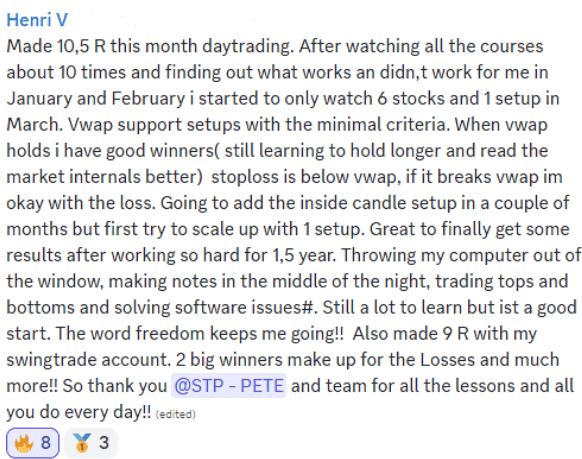
"Made 10.5R this month"
That's $10,500 profit risking only $1,000 per trade
Al T's Income Doubled
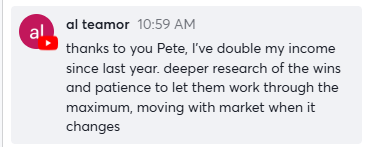
"Doubled my income since last year"
Patience and deeper research paying off
Walter's Breakthrough
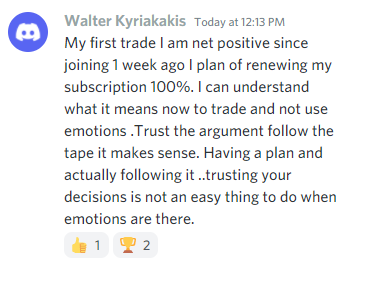
Real community support
See how our members help each other succeed
Chris M's Success
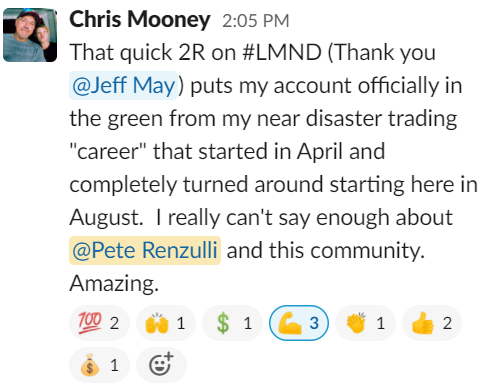
Structured approach wins
Transformation through proven methods
All screenshots are unedited and taken directly from trading platforms and community posts
This isn't about promising you'll make millions.
This is about giving you the strategies, tactics and mindset to proudly call yourself a profitable trader.
Because here's the truth: You probably already know enough about technical analysis to be profitable.
What you're missing is a step-by-step system and the emotional discipline to apply that knowledge consistently when real money is on the line.
And that's exactly what we fix.
Here's what actually happens when you start using this system.
You know that crushing feeling when you're sitting at your desk watching a winner turn into a loser because you didn't know when to exit?
That disappears completely.
Because when you risk exactly 1.5% per trade and follow mechanical rules for adding to winners, every trade has clear boundaries.
I had a student tell me last week,
"I used to sit there paralyzed, watching my $300 winner slowly bleed back to breakeven.
Now I have exact rules for when to add, when to trail, and when to exit. No more guessing."
And here's the crazy part — you'll actually start looking forward to small losses.
I know that sounds insane, but when you're only risking $150 on a $10,000 account, a loss just means you get to deploy that capital on the next setup within the same session.
 No more of those gut-wrenching moments where you risk $500 on a "sure thing" breakout that immediately reverses and wipes out three days of careful scalping profits.
No more sitting there at 3:50 PM with a $200 winner, sweating over whether to hold for the last 10 minutes or take profits now.
Instead, you're the trader who takes a starter position on the breakout, adds shares when it clears the next level, and then systematically trails your stop as it runs.
While everyone else is white-knuckling their mouse wondering if they should "take profits now," you're mechanically extracting every point the market wants to give you before the close.
Your trading buddies will ask how you stay so calm during choppy market days, and honestly, you'll simply explain that when you have a system, individual trades just don't rattle you anymore.
So the question isn't whether this system works — the community proves it does.
The question is whether you're ready to make the shift from hoping and guessing to systematic profit extraction.
Inside the Daily Deposits course, I'll walk you through the exact same transformation that took me from losing $7,500 in one day to consistent profitability.
You'll get the precise position sizing formulas, the mechanical rules for building winners, and the exit strategies that squeeze every dollar from each opportunity.
But here's the thing— I can only work with a limited number of serious traders who are committed to making this change. This isn't for tire-kickers or people looking for another "strategy" to add to their collection.
If you're ready to stop day trading like everyone else and start operating like the 1% who actually make money, here's how we can work together...
MONTHLY
Perfect for testing the system
$199/m
BEST VALUE
ANNUAL
Best value for serious traders
~~ Save $488! ~~
$1900/y
Everything in Monthly PLUS:
REMEMBER - A single blown account can cost you $10,000, $25,000, or more.
One coaching session with a former NYSE specialist would cost $500+ per hour.
You're getting unlimited access to the same systematic approach for less than $7 per day.
Compare your options:
Keep losing $500-2,000/month on emotional trades: FREE (but costs you everything)
Hire a private trading coach: $500+/hour (if you can find one with my background)
Keep jumping from system to system: $297-997 each (plus the opportunity cost)
Get the complete systematic approach that actually works: $158 - $199/month
Your Two Choices Right Now
Choice 1: Close this page, go back to doing what you've been doing.
Six months from now, you'll still be having that same internal argument before every trade. You'll still be selling winners too early and holding losers too long.
And you'll still be wondering why some traders seem to have it figured out while you're stuck breaking even.
Choice 2: See what systematic trading actually feels like. Follow a proven checklist instead of your emotions. Learn from someone who's been on both sides of this game.
And finally experience what it means to trade with conviction instead of hope.
The market doesn't care which choice you make. But your future self will thank you for choosing wisely today.
Every day you wait is another day you're essentially paying the market for an expensive education you could get systematically. Last week alone, how much did emotional trading cost you? $200? $500? $1,000?
That's more than this entire month's membership. And unlike market losses, this investment actually teaches you something you can use forever.
See what Henri, Al, Walter, and hundreds of others already discovered: systematic trading isn't just more profitable - it's actually enjoyable.
Frequently Asked Questions
"What if this doesn't work for me like all the other systems I've tried?"
I get it. You've been burned before. Here's the difference: This isn't another strategy to memorize or signals to follow. It's a systematic checklist that removes the guesswork entirely.
The system works because it's based on how institutions actually move money, not theories or hunches.
"I'm in my 50s/60s... am I too old to learn this?"
Actually, you're the perfect age. Our most successful students are exactly your demographic—people with life experience who value structure over hype.
You're not trying to become a day trading cowboy. You want a systematic approach that works without drama. That's exactly what this is designed for.
"What kind of results can I realistically expect in my first 30-60 days?"
I can't promise specific dollar amounts - that depends on your account size and how consistently you follow the system. But here's what you can expect:
Week 1-2: You'll feel more confident entering trades because you're following a checklist instead of emotions
Week 3-4: You'll stop second-guessing every decision and start trusting the systematic approach
Week 6-8: Trading will feel less stressful because you're not constantly fighting your instincts
The money follows when you have the right system and stick to it. Our students report making better decisions, not just bigger profits.
"I work during market hours - can I still day trade?"
This depends on your time zone and work schedule. Let me be completely honest about what works and what doesn't:
If you're on the East Coast and work 9-5: Day trading isn't realistic. You'd be trying to trade during your work hours, which leads to costly mistakes and blown accounts. Consider swing trading using the same Order Flow Stacking principles.
If you're on the West Coast: Many of our members day trade from 6:30-8:30 AM Pacific (9:30-11:30 AM Eastern) before heading to work. This is actually ideal timing since the first 2 hours are typically the most volatile and profitable for day trading.
If you're international: Depending on your time zone, you might be able to day trade US markets after your work day. For example, members in Asia and Australia often trade US markets in their evening hours.
The key: Don't try to day trade while working your regular job. It requires full attention during the most volatile market periods. But with the right time zone situation, you can absolutely day trade before or after work.
If your schedule doesn't align with focused day trading hours, our Order Flow Stacking system works excellently for swing trading - same analysis, longer time horizons.
"I don't have enough capital to day trade"
You don't need a $25,000 PDT account to learn this system. Many of our members start by paper trading or using the system for swing trades until they build their account. The Order Flow Stacking principles work the same whether you're trading 100 shares or 1,000 shares. Start where you are, build systematically.
"What if I need help along the way?"
You're not alone in this. You'll get access to our active Discord community where Pete and the team provide daily guidance. And you get 2x weekly coaching sessions.
Plus annual members get 24/7 AI coaching support and a 1:1 onboarding call to make sure you start on the right foot.
We're invested in your success.
"What if I can't attend the coaching sessions?"
All coaching sessions are recorded and available within hours.
Plus, annual members get AI coaching support for immediate answers. The system is designed to work around your schedule, not control it.
Look, you're here because something isn't working.
Maybe it's the emotional roller coaster...
Maybe it's the inconsistent results...
Maybe you're just tired of feeling like you're guessing...
The good news?
You're closer than you think.
You already understand charts, you know the risks, and you're committed enough to read this far.
You just need the systematic approach that connects everything together.
Don't let this be another page you bookmark and never act on.
Your trading doesn't have to stay the same.
Questions? We're here to help. [email protected]